
Measured data turns safe transport into a premium.
A logistics AI standard that normalizes the measured data Carbon DTG reads directly from the vehicle, to power the shift to safe transport. Through a single API and MCP it does more than safety — it also runs carbon-data analysis and LCS API functions: an AX product that stands one tier above LCS.
One standard, working through three tools.
LAS puts measured data to work in three places: a Chrome extension that reads shipper orders automatically, a paid subscription plugin you switch on inside LCS Cloud, and tool widgets your team arranges itself. All in development; the real screens follow as they are ready.
Chrome extension · data capture
Reads the computerized order data on a shipper’s screen automatically and organizes it into standard order data. It moves into the system only after a person confirms it.
LCS Cloud paid-subscription plugin
Switch the plugin on inside LCS Cloud, and workspace, safety analysis and conversational AI open up in turn by subscription stage.
Agent tool widgets
Pick the tool widgets you need and compose your own workspace — safety, carbon and citations in one place.
The real product screens will be reflected as they are prepared with the product team. What you see here is a feature overview; subscription stages and pricing follow once confirmed.
It fills the blanks — without inventing them.
The activity gap-fill console in LCS Cloud is a real, working screen. Enter transport details and a physical model fills the missing values (fuel, empty-run rate, load factor), tagging each with its source — entered, model-estimated, or default. What it cannot fill stays "unknown", not zero, and the result is sealed with a record_hash against tampering.
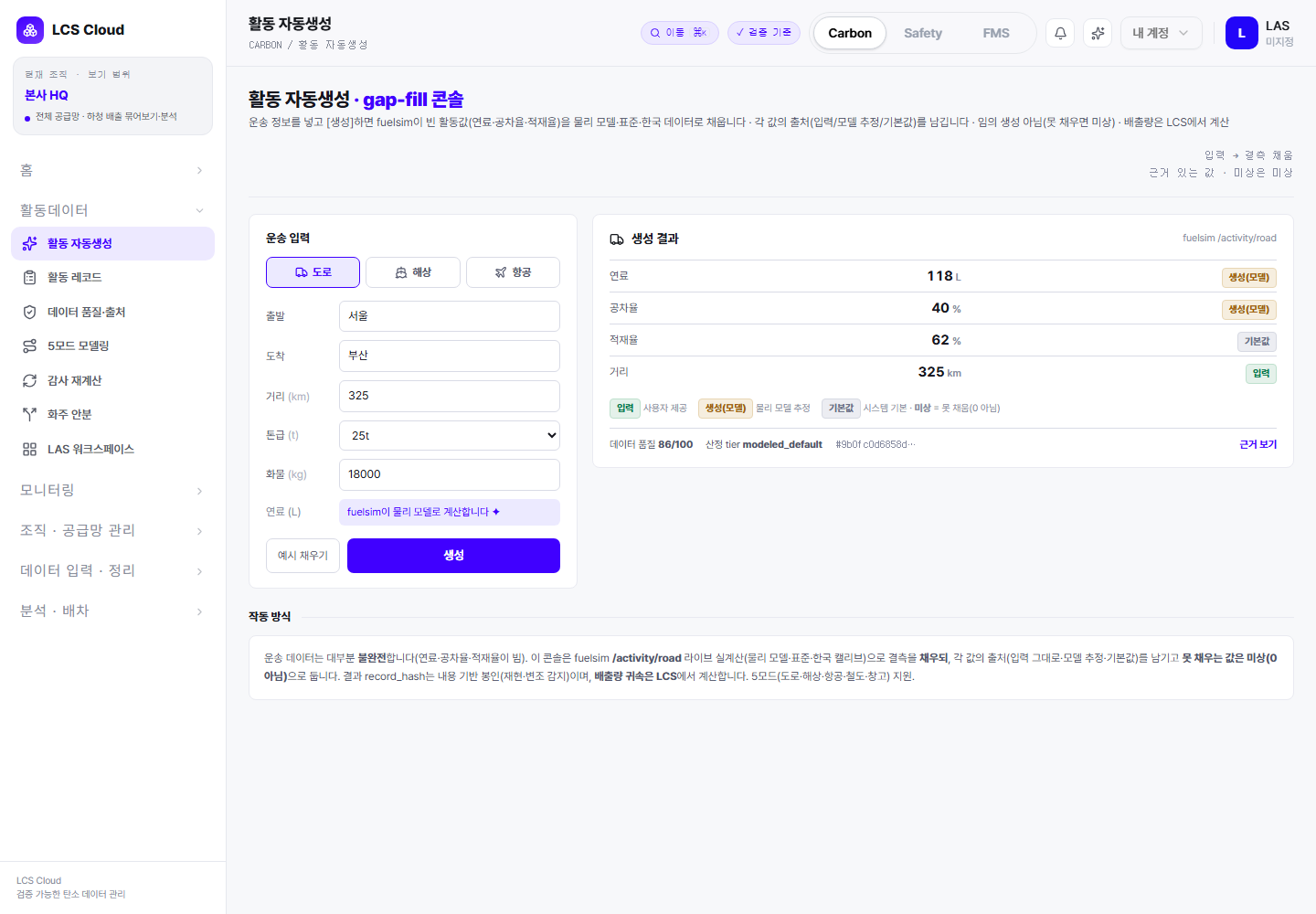
A real LCS Cloud console screen (example transport input). Each value shows its source — entered, model-generated or default — and unfilled values stay unknown, not zero. Emissions are computed in LCS.
One tier above LCS.
Through API and MCP, LAS runs not only safety but also carbon-data analysis and LCS API functions in one place. It includes everything LCS does, and adds safety and conversational AI on top.
LAS runs them as-is — carbon-data analysis and LCS API functions.
On the same measured data, it adds safe-driving and operation analysis.
Carbon and safety together through one API·MCP — an AX product one tier above LCS.
Measure it, and it becomes a premium.
Measurement opens two premium shifts — carbon (LCS) into green transport, safety (LAS) into safe transport. Both are proven by data, so both return as pricing.
Measured carbon data lowers your shippers’ Scope 3 and connects verified green transport to premium orders.
Measured safety data proves safe operation and connects it to premium hazmat and high-value freight.
Both shifts are proven by sealed measured data, not claims — so they return as your wins, pricing, and reduced risk.
Proof coordinates — the green premium on lcs_record_hash, the safety premium on score_hash. Both are sha256 deterministic seals, so you bring reproducible data to the pricing table, not a claim.
Safety, handled as data.
Automated safe-driving score
Normalizes driving, hard accel/braking, idling and more that Carbon DTG measures, into an automatic safety score.
Safe-operation analysis
Analyzes risk patterns by vehicle, driving, and route to identify where and which vehicles need safe transport.
Safe-vehicle dispatch support
Helps prioritize verified-safe vehicles for hazmat, explosives, semiconductors and other loads that require safe transport.
Routes that lower the accident rate
Proposes routes that avoid black-ice risk zones and accident-prone segments — reducing the chance of an accident itself.
Conversational AI · Q&A
Grounded in normalized safety data, teams ask in natural language and get answers with their evidence.
Carbon analysis · LCS API, unified
On the same surface it also runs carbon-data analysis and LCS API functions — safety and carbon through one API·MCP.
The score comes from signals the vehicle actually made.
Safe-driving scores aren't invented. Carbon DTG already reads risk-driving signals; we normalize them per 100 km and compute them with a version-pinned deterministic function. Rules make the number, not the AI — the AI only does data processing and cited Q&A.
Each score is sealed as an sha256 of its input vector (score_hash) — reproducible and verifiable, the same way carbon emissions are sealed. No data (DTG unlinked) shows as "not measured", never zero (n/a ≠ 0). Hazmat dispatch safely excludes vehicles without a score.
AI does the method; data does the verdict.
LAS’s AI doesn’t invent numbers. It generates and answers only through a normalized data-processing methodology, while safety scores and verdicts are computed deterministically. Every output carries its source.
- Uses only normalized measured data — no fabricated estimates
- Numbers and verdicts are deterministic · AI assists method and narrative
- Every AI output shows its provenance · n/a ≠ 0
- Evidence is sealed measurement — data, not claims
Build easily, with Claude Code.
Experiment in the playground, integrate via the API, and build straight from Claude Code with LAS MCP (agent-to-agent).
A space to experiment with safety and carbon analysis conversationally.
Beyond safety scores and analysis, wire in carbon analysis and LCS API functions as one.
Agent-to-agent protocol for Claude Code developers.
LAS MCP includes LCS MCP as-is (all carbon tools) and adds safety and conversational tools on top. Scores and verdicts are deterministic (score_hash sealed); matching is a recommendation, not auto-dispatch. (In development)
Ask the methodology, now
Ask about safety and carbon methodology in natural language and get answers with their basis. Concrete values like safe-driving scores or carbon figures are computed deterministically from measured data; this demo only answers methodology.
In-development demo · methodology Q&A only · numbers/verdicts belong to the deterministic engine (measured data) · answers carry their source