
LTS Cloud
LTS offers LTS Cloud as two web services: one forprimary contractors, one for subcontracted carriers
Primary contractor HQ receives the part of partner carriers' transport data that covers its own cargo and reports it to shippers. Subcontracted carriers manage trip records for their own vehicles and submit the data primary contractors request.
LTS Cloud for primary contractor HQ
Primary contractor HQ receives the part of partner carriers' trip, fuel, electricity and risky-driving records that covers its own cargo, and issues emissions and safety records per shipper.
- Automatic collection of partner carriers' transport data
- Emissions and safety records issued per shipper
- Primary, secondary or default quality grade for each data point
LTS Cloud for subcontracted carriers
Subcontracted carriers manage trip records for their own vehicles and submit the data primary contractors request directly from LTS Cloud for carriers.
- Vehicle, driver and trip record management
- Submission of data requested by primary contractors
- Driver safe-driving report
Actual screens
In LTS Cloud, primary contractors collect trip records,calculate emissions and issue shipper reports
Shows the trip route, trip summary, risky-driving events and caution and abnormal events on one screen.
Calculation standards
LTS Cloud uses international standards and Korean emission factorsto calculate per-cargo emissions
ISO 14083Well-to-Wheel
LTS Cloud calculates transport emissions in line with ISO 14083:2023 and the GLEC Framework.
SFC certification CRT 020GLEC Framework
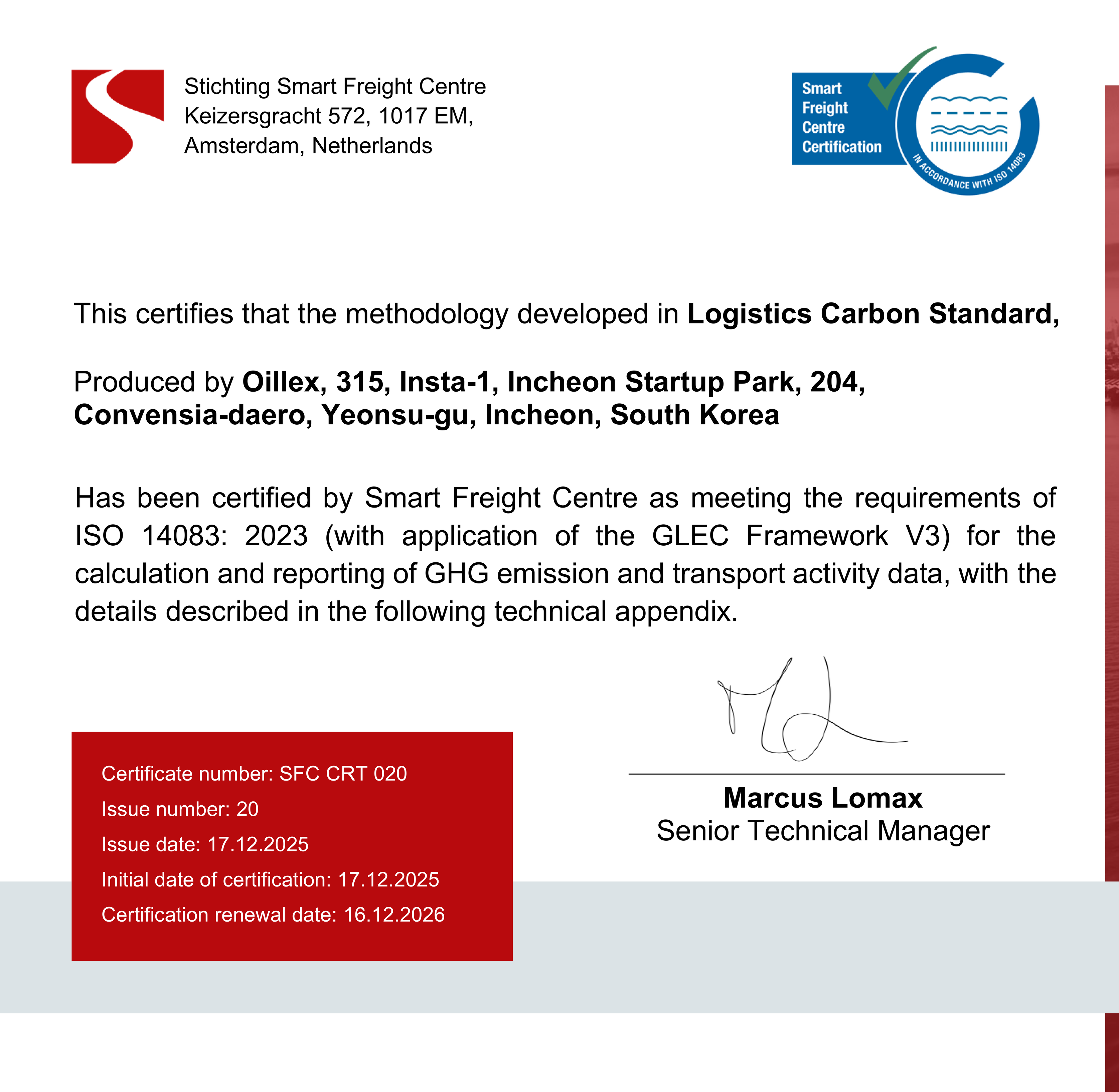
LTS Cloud is the first tool in Korea certified by SFC under the GLEC Framework.
Korean emission factors22% difference for heavy trucks
LTS Cloud calculates with Korean emission factors. For heavy trucks, the results differ by 22% from products that use European factors.
LCS engine API integration
LTS Cloud connects to primary contractors' IT systems throughthe LCS engine API and collects data from sites that cannot switch
If primary contractors' IT systems or partner carriers' monitoring systems are hard to replace, only the data is connected through the LCS engine API and the collection scope is kept.
Data exchanged
Primary contractors' IT systems collectthree types of data through the LCS engine API
Collects trip time, distance and location (GPS) plus fuel and electricity consumption for each vehicle.
Collects per-cargo emissions that LAS has split by primary contractor.
Collects risky-driving determinations and evidence waveform records.
Integration steps
Primary contractor IT teams completeLCS engine API integration in five steps
Decide the data to exchange and the partner carriers in scope.
Create an API key in LTS Cloud and authenticate.
Align fields in the existing system with the LTS Cloud format.
Confirm data exchange with sample data.
Exchange data on a set schedule.
Talk to us
In a consultation, primary contractors and carriers setthe account setup and integration scope for both web services
In a consultation, an LTS representative explains the scope and terms of adoption for your fleet size and partner-carrier structure.