Primary contractor HQ · large logistics companies

Primary contractor HQ collects transport data from subcontracted carriers' vehicles directly in LTS Cloud

When partner carriers install LTS DTG in their vehicles and use LTS Cloud for carriers, trip, fuel, electricity and risky-driving records are collected automatically in LTS Cloud for primary contractors. The quarter-end work of requesting Excel files and re-entering them ends.

01 Problem

Partner carriers and owner-drivers move most contracted cargo,so the HQ monitoring system cannot collect those trip records

Data collection stopsShipperRequests emissions and safety recordsOwn fleetPrimary contractorMonitors only its own fleetSubcontracted carriersOwn monitoring and ExcelSecond-tier carriersHandwritten recordsOwner-drivers90% of trucksEmissions reportedto shipperEstimateNo measured basisTrip dataDispatchShipperRequests emissions and safety recordsOwn fleetPrimary contractorMonitors only its own fleetData collection stopsSubcontracted carriersOwn monitoring and ExcelOwner-drivers90% of trucksSecond-tier carriers·  Handwritten recordsEmissions reportedto shipperEstimateNo measured basisTrip dataDispatch

02 If left as is

As shippers demand better-verified emissions and safety records,estimate-based reports cannot meet contract logistics bids

2027 · Trip recorder standard revision

The Ministry of Land, Infrastructure and Transport accepted the carbon management criteria LTS proposed, and the standard revision process has begun.

2028 · Disclosure takes effect

Shippers must report Scope 3 transport emissions and ask primary contractors for the supporting data.

Contract logistics bids

Primary contractors must submit per-cargo emissions in an international-standard format to take part in bids.

03 Current flow and LTS flow

Today, primary contractors estimate emissions from partner Excel;with LTS, they collect raw vehicle data mapped by LAS

Current flow

  1. Request Excel files from partner carriers
  2. Carriers gather fuel receipts
  3. Primary contractor re-enters data by hand
  4. Estimate with European factors and average fuel economy
  5. Report at quarter end
No fuel or electricity fields in the legally mandated trip recorderCarriers refuse to submit because costs and accident liability are exposedConsolidated (mixed) loads cannot be split by shipper

LTS flow

  1. LTS DTG collects CAN signals every 0.1 s
  2. Stored in LTS Cloud for carriers
  3. LAS maps orders and dispatches
  4. Data for the contractor's own cargo sent to LTS Cloud for primary contractors
  5. Shipper reports and safety records issued
Fuel and electricity measured from CAN signalsCarrier costs are not exposed to other primary contractorsConsolidated (mixed) loads also calculated per cargo

04 LAS determination

LAS maps orders to dispatches and confirmswhich primary contractor receives the data

Order table · two rowsShipperPickupDrop-offPlate no.Shipper AShipper BState computed onceVehicle signals · valuesState builder describes each segmentTable type?Order listDispatch sheetOrder listDispatch sheetWhich column is pickup?Col 1Col 2Col 3Col 1Col 2Col 3Hazmat in first row?YesNoYesNoPlate number present?YesNoYesNoISO 14083 field coverage?12341234ChoiceTable typeShipment order listConfidence 1.00Yes/NoFirst-row hazmatProbability of true 0.12ScoreISO 14083 fields metExpected level 2.981234Probabilityof true01Low thresholdHigh thresholdConfirm No at onceLAS second passConfirm Yes at once
1 truck · 3 consolidated loads1 trip · one fuel signal per vehicleContractor A · 3.2 tSeoul→DaejeonContractor B · 2.6 tSeoul→DaeguContractor C · 1.8 tSeoul→BusanVehicle signal · LTS DTGFuel rate, distance, time — not split by cargoOrder · dispatch dataOrder · dispatch dataLAS engineMaps order × dispatch × vehicle signalWhich cargo was loaded?Which cargo was loaded?Do segment and time match?Do segment and time match?Tonne-km for each cargo?Tonne-km for each cargo?Tonne-km allocationTonne-km allocationDeterminingDeterminedContractor A cargo3.2 t × Seoul→Daejeon distance= tonne-km → cargo's emissionsContractor A cargo3.2 t × Seoul→Daejeon distance= tonne-km → cargo's emissionsContractor A viewScope 3 transport emissionsContractor B cargo2.6 t × Seoul→Daegu distance= tonne-km → cargo's emissionsContractor B cargo2.6 t × Seoul→Daegu distance= tonne-km → cargo's emissionsContractor B viewScope 3 transport emissionsContractor C cargo1.8 t × Seoul→Busan distance= tonne-km → cargo's emissionsContractor C cargo1.8 t × Seoul→Busan distance= tonne-km → cargo's emissionsContractor C viewScope 3 transport emissionsUnclassified cargo → LAS second-pass determinationAmbiguous cargo is checked against all candidate ordersin the LAS second pass and confirmed · this trip: 0
Primary contractorLTS Cloud
LTS Cloud risky-driving event screen
Safety · risky-driving determination
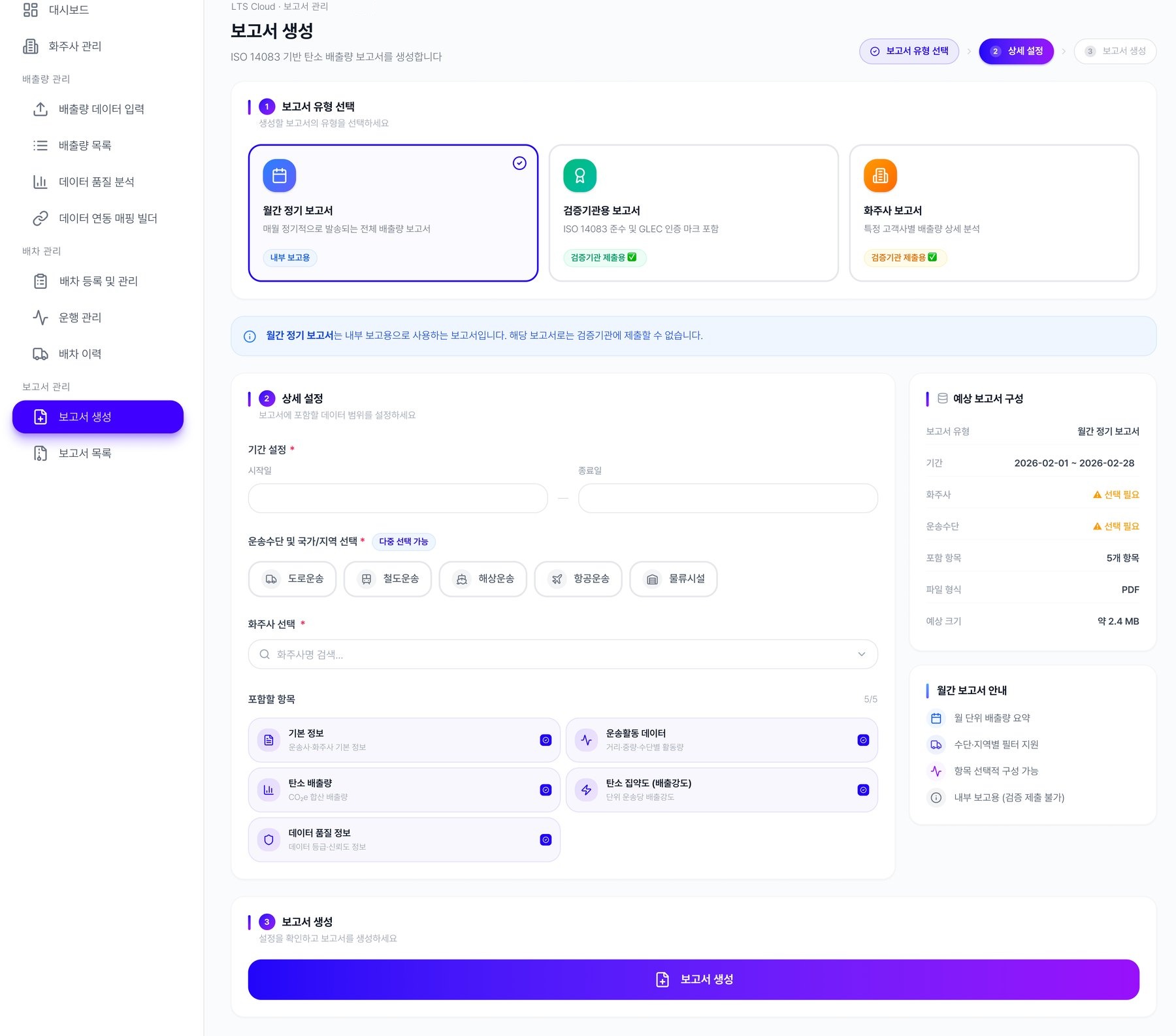
LTS Cloud report creation screen
Carbon · per-cargo emissions calculation
ShipperPer-cargo report
Safety · risky-driving determination
Carbon · per-cargo emissions calculation
ISO 14083SFC certification CRT 020GLEC Framework

LAS measured · 180 dispatches

The LAS engine resolved 180 dispatches in 5.0 seconds,35× and 95× faster than two frontier language models

5.0 sTo resolve all 180 dispatches
35×Speed vs. Claude Fable 5.1
95×Speed vs. GPT-6 Astra

LTS measurement 2026-09-29 · median of 3 runs per engine · all three engines correct in all 3 runs

07 Comparison

When primary contractors compare both methods on the samepartner vehicles, interval, evidence and cost protection differ

CriterionCollecting Excel files from partner carriersLTS
Collection methodRequest Excel files from partner carriersAutomatic collection by in-vehicle device
Sampling intervalIn bulk at quarter endCollected every 0.1 s · available as soon as a trip ends
Fuel and electricityEstimated from receipts and average fuel economyMeasured from CAN signals
Safety recordsLooked up after an accident11 types of risky driving determined during the trip
Consolidated (mixed) loadsCannot be split by shipperCalculated per cargo through LAS order and dispatch mapping
Emission factorsEuropean factorsKorean emission factors · SFC certification CRT 020
Carrier costsAll raw data submitted to the primary contractorOnly data for each contractor's own cargo is delivered

Companies and institutions we work with

Logistics companies and public institutions have startedmeasuring transport data with LTS

Hanjin
Sunjin Networks
Samsung Fire & Marine Insurance
Hwamulman
Yeosu Gwangyang Port Authority
Incheon International Airport Corporation
Bodyfriend

Talk to us

In a consultation, primary contractor HQ explains itspartner structure and receives a plan covering shipper reports

In a consultation, an LTS representative explains the scope and terms of adoption for your fleet size and partner-carrier structure.

Request a consultation

We use your details only to respond to your request.

Primary contractor HQ | LTS